Options Trading Strategies for Beginners: Risk, Reward, and Common Setups
Options can be used to bet on direction, to earn income, to protect a portfolio or to trade a range. That flexibility is what makes them useful, and also what makes them dangerous for beginners: every strategy has a different shape of risk and reward, and some carry losses far larger than they first appear. This guide covers the essential risk and reward concepts, then walks through common beginner setups with worked examples.
Risk and reward: four numbers to know before any trade
- Maximum profit: the most the position can make.
- Maximum loss: the most it can lose. Some strategies have unlimited or very large maximum loss.
- Breakeven: the underlying price at which the position neither makes nor loses money at expiry.
- Margin: the capital the broker blocks to hold the position. Selling options requires far more margin than buying them.
If you cannot state these four numbers for a trade, you are not ready to place it.
Buyers vs sellers
- Option buyers pay a premium. Their loss is limited to that premium, but they need the underlying to move far enough and fast enough. Time decay (theta) works against them every day.
- Option sellers collect a premium. Time decay works in their favour and they win more often, but a single large move can produce losses many times the premium collected.
Common setups for beginners
The examples below assume NIFTY at 25,000. Premiums are illustrative and quoted in points per unit.
1. Long call (bullish)
Buy the 25,000 call for 150.
- Max loss: 150, the premium paid.
- Breakeven: 25,150.
- Max profit: open-ended above the breakeven.
- Best when: you expect a strong move up soon. A slow drift higher may not beat time decay.
2. Long put (bearish or protective)
Buy the 25,000 put for 140.
- Max loss: 140.
- Breakeven: 24,860.
- Best when: you expect a sharp fall, or want to protect an existing long position.
3. Bull call spread (moderately bullish, defined risk)
Buy the 25,000 call for 150 and sell the 25,200 call for 70.
- Net cost: 80, which is also the max loss.
- Max profit: 200 − 80 = 120, if NIFTY expires at or above 25,200.
- Breakeven: 25,080.
- Why it suits beginners: cheaper than a long call and less hurt by time decay, with both risk and reward capped.
4. Bear put spread (moderately bearish, defined risk)
Buy the 25,000 put for 140 and sell the 24,800 put for 65.
- Net cost and max loss: 75.
- Max profit: 200 − 75 = 125, if NIFTY expires at or below 24,800.
- Breakeven: 24,925.
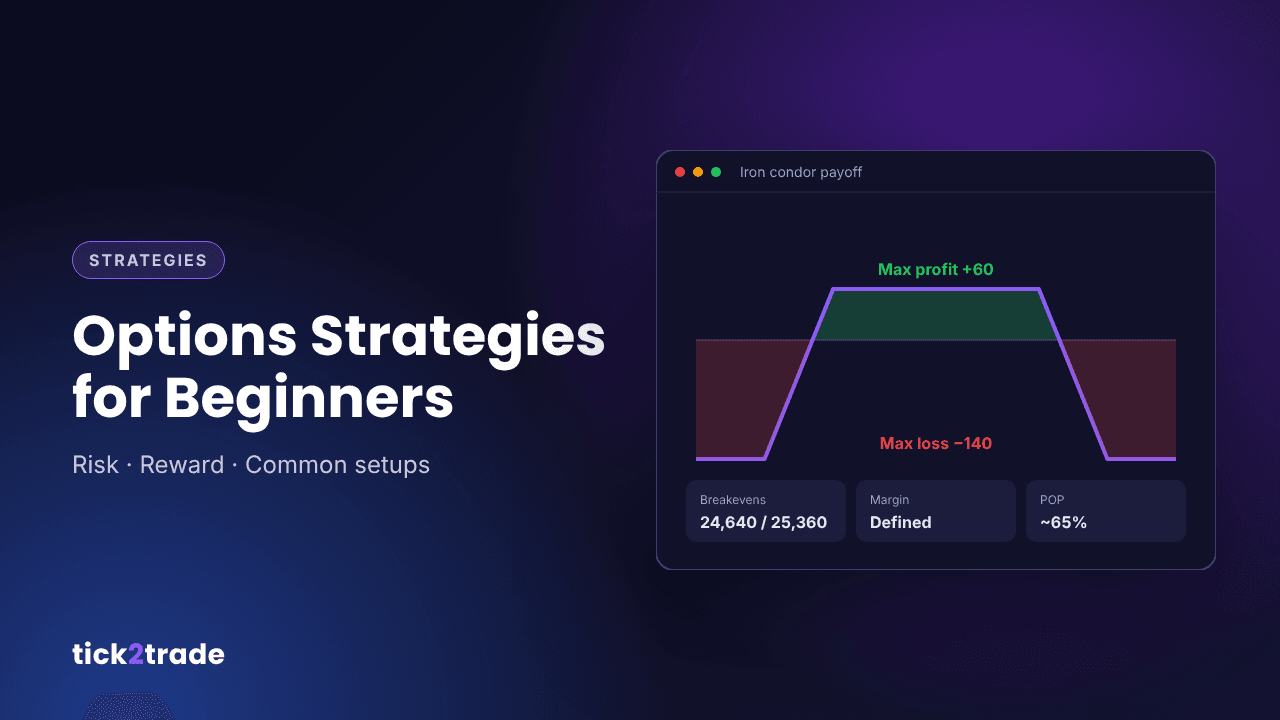
5. Iron condor (neutral, defined risk)
Sell the 24,700 put and the 25,300 call, and buy the 24,500 put and the 25,500 call as protection. Assume a net credit of 60.
- Max profit: 60, if NIFTY expires between 24,700 and 25,300.
- Max loss: 200 − 60 = 140, if NIFTY expires beyond either wing.
- Breakevens: 24,640 and 25,360.
- Note: it wins often but loses more than it makes when it loses. Position size and exits matter.
Strategies to approach with caution
- Naked short calls and puts, short straddles and short strangles have very large or unlimited loss potential and high margin requirements. Learn their defined-risk versions first, such as the iron condor or iron butterfly.
- Deep OTM option buying looks cheap but usually expires worthless.
- Holding long options through events can lose value even if you get the direction right, as implied volatility falls afterwards.
Rules that protect beginners
- Start with defined-risk strategies, where max loss is known in advance.
- Risk a small, fixed percentage of capital per trade.
- Decide your exit, both stop and target, before you enter.
- Check liquidity: trade strikes with tight bid-ask spreads.
- Practise first. Read what is paper trading.
How Tick2Trade helps you trade strategies safely
- Templates by market view. The strategy builder groups ready-made strategies under bullish, bearish and neutral, each with a one-line description of when it fits.
- Risk before reward. Max profit, max loss, margin, breakevens, Greeks and probability of profit update live as you change any leg.
- What-if scenarios. Adjust spot, IV and days to expiry to see how the position would behave.
- Basket-level exits. Set a stop-loss, target and trailing stop on the whole position.
- All legs in one order. Tick2Trade is a SEBI-registered broker's own terminal, so the strategy you design is the order you place. See our strategy builder guide.
Risk disclosure: Trading in futures and options involves substantial risk. SEBI studies have found that about 9 out of 10 individual F&O traders incurred net losses. Premiums in this article are illustrative; check live prices before trading. This article is for education only and is not investment advice. Tick2Trade is a brand of Besseggen InfoTech LLP, SEBI Reg. No. INZ000213450.