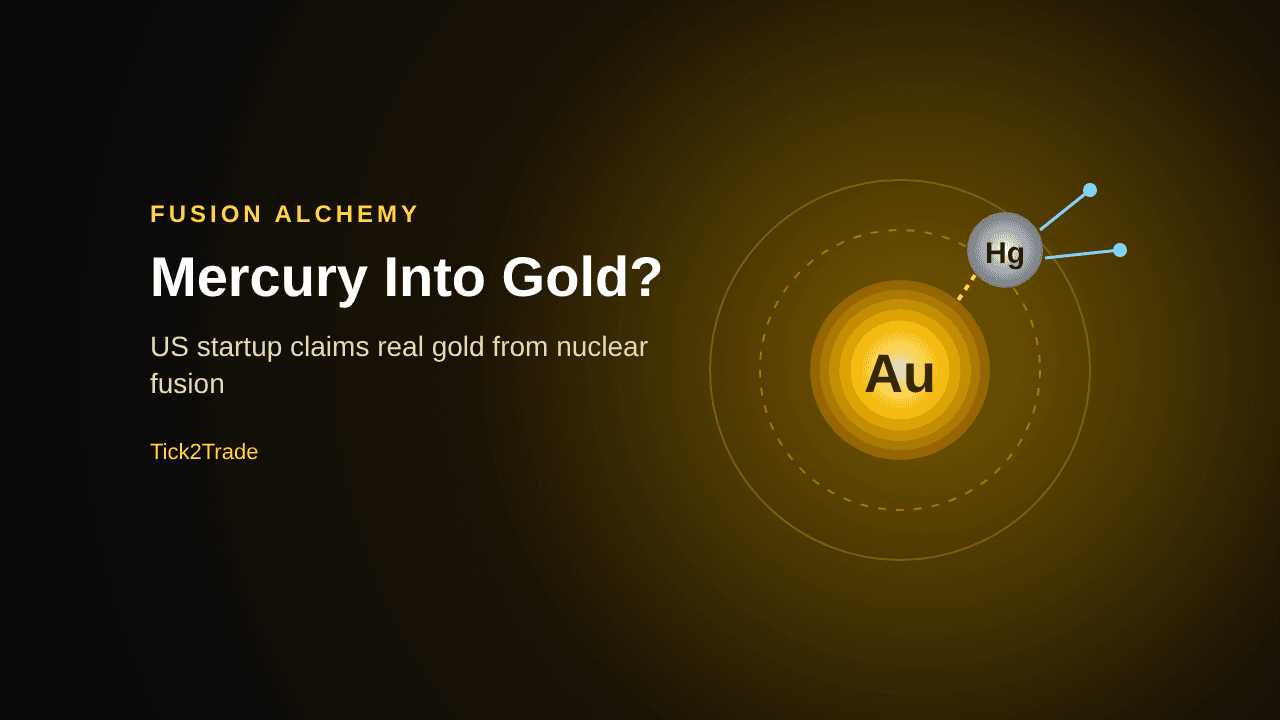
US Startup Claims It Turned Mercury Into Real Gold Using Nuclear Fusion: What We Know So Far
A San Francisco startup says it has done what medieval alchemists only dreamed of: turning mercury into real, stable gold. Marathon Fusion announced on October 21, 2026 that it converted mercury into gold in September using neutrons produced by nuclear fusion, and claims the production rate is ten times higher than CERN's record. The result is a company claim and has not yet been independently verified.
How does the process work?
Natural mercury contains about 10% mercury-198. When a fusion reaction between deuterium and tritium releases a high-energy neutron (about 14 MeV), that neutron can knock a neutron out of a mercury-198 nucleus, leaving mercury-197. Mercury-197 is unstable and decays, with a half-life of roughly 64 hours, into gold-197, the only stable isotope of gold. The same reaction releases an extra neutron, which could also help breed tritium fuel for the reactor.
How is this different from CERN?
Between 2015 and 2018, CERN's Large Hadron Collider created gold nuclei, but only about 29 picograms in total, and they existed for a fleeting moment before being destroyed. Marathon says its gold is real and stable. Transmutation of mercury into gold was first achieved in 1941, but that gold was radioactive and unstable.
Could gold make fusion power plants pay for themselves?
Marathon's projections suggest a future fusion plant could produce around five tonnes of gold per gigawatt of capacity each year. A 2025 preprint that has not been peer reviewed estimates about two tonnes per gigawatt of thermal power, and the two figures use different measures. If 100 such plants existed, output could reach about 500 tonnes a year, roughly 14% of annual mined gold. Gold could, in theory, double the revenue of a fusion plant without reducing its electricity output.
What are the doubts?
Marathon has not disclosed how much gold it produced, what it cost, or the purity and yield. It has shared gamma-ray spectra showing mercury-197 and gold-197 signatures, but outside researchers have not replicated the work. Its current reactor reportedly runs at only about 1 kW of fusion power, far below commercial scale, and fusion plants that sell electricity do not exist yet. The process can also create radioactive gold isotopes, which may need 14 to 18 years of storage before sale. Enriching mercury-198 adds cost, and mercury is toxic. A Princeton plasma physicist not involved in the work said it looks great on paper.
What does it mean for gold prices and investors?
If gold from fusion ever became cheap and abundant, it could pressure prices, much as lab-grown diamonds cut wholesale diamond prices by 90 to 95% since 2015. That is a long way off, though. For now, this is an early, unverified claim, and traders should treat it as a headline to watch rather than a reason to change positions. This article is for information only and is not investment advice.
Key takeaways: the physics is plausible, but the amount, cost and independent verification are still missing. Watch for data disclosure, third-party confirmation, and progress on Marathon's planned San Francisco fusion reactor.