SEBI Revises NSE Closing Auction Session Rules: New CAS Timings and F&O Settlement Changes
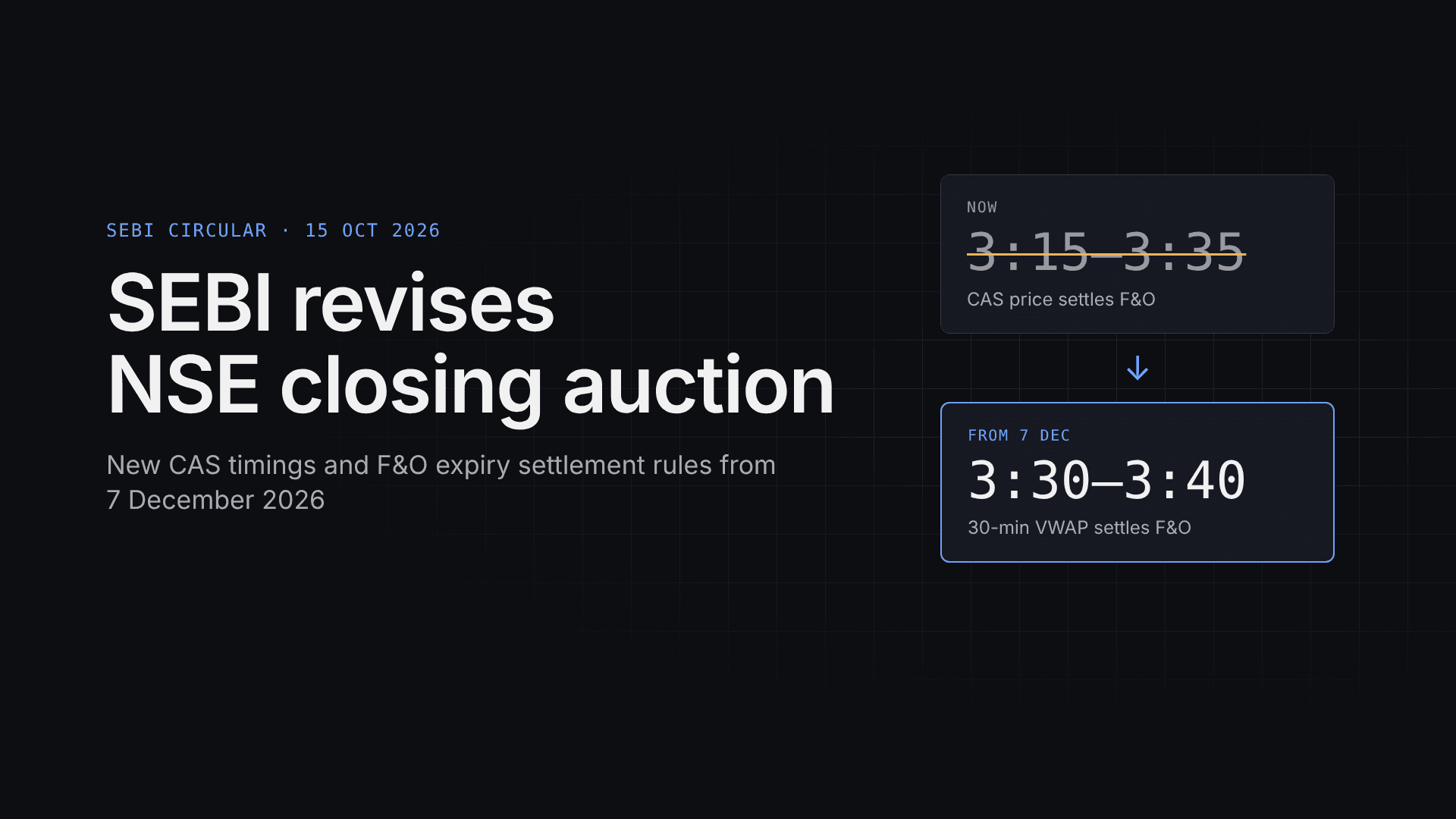
On 15 October 2026, SEBI issued a circular revising the Closing Auction Session (CAS) that began in the equity cash segment on 3 August 2026. The changes move the auction to after 3:30 PM, extend derivatives trading to 3:45 PM, and, most importantly for F&O traders, stop using the auction's closing price to settle expiring stock and index derivatives. None of this applies yet. The revised provisions are scheduled to take effect on 7 December 2026, and one part (carry-over of unexecuted orders) from 8 February 2027. Until then, the current CAS rules continue.
This article covers only what changed and how it affects you. If you are new to the auction itself, start with our guide on how the NSE Closing Auction Session works.
Key changes at a glance
- New CAS window: a single 10-minute auction from 3:30 PM to 3:40 PM on all trading days, after regular trading ends at 3:30 PM.
- Order entry: market and limit orders from 3:31 to 3:36 PM, limit orders only from 3:36 PM, with order entry closing at a random time between 3:38 and 3:40 PM.
- Expiry settlement: expiring stock and index derivatives will settle on the VWAP of the last 30 minutes of continuous trading, not on the CAS closing price.
- Derivatives hours: trading until 3:45 PM; expiring index contracts stop at 3:30 PM on expiry day, while stock derivatives trade until 3:45 PM even on expiry day.
- Post-close session: continues from 3:50 PM to 4:00 PM in the cash segment, at the closing price.
- Effective date: 7 December 2026 (8 February 2027 for carried-over orders).
Why SEBI revised the CAS framework
SEBI released a consultation paper on 12 September 2026 after feedback from exchanges, brokers and investors in the first weeks of CAS. Concerns included sharp movements in the indicative index value during the auction and in expiring index options, and the uncertainty created by letting the auction price decide expiry settlement. The paper also noted that derivatives activity stayed heavily concentrated near the close: on NSE, average option premium traded per minute in the 3:20 – 3:30 PM window was about ₹190 crore, compared with about ₹126 crore per minute in the 3:00 – 3:30 PM window before CAS.
After reviewing public comments and the recommendations of its Secondary Market Advisory Committee, SEBI chose to restore a longer continuous session, run the auction after it, and keep expiry settlement on a continuous-trading VWAP while CAS liquidity develops.
Old vs new: comparison table
| Rule | Current rules (3 Aug – 6 Dec 2026) | Revised rules (from 7 Dec 2026) |
|---|---|---|
| Continuous trading ends (CAS stocks) | 3:15 PM | 3:30 PM |
| Closing auction window | 3:15 – 3:35 PM (20 minutes including matching) | 3:30 – 3:40 PM (10 minutes) |
| Reference price and transition | 3:15 – 3:20 PM | 3:30 – 3:31 PM |
| Market + limit order entry | 3:20 – 3:25 PM | 3:31 – 3:36 PM |
| Limit-only order entry | 3:25 – 3:30 PM | 3:36 – 3:40 PM |
| Random closure of order entry | Between 3:28 and 3:30 PM | Between 3:38 and 3:40 PM |
| Order matching | 3:30 – 3:35 PM | After random closure; price published as soon as practicable |
| CAS reference price | VWAP of 3:00 – 3:15 PM trades | VWAP of the last 15 minutes of continuous trading (3:15 – 3:30 PM) |
| Index derivatives trading ends | 3:40 PM | 3:45 PM; expiring contracts stop at 3:30 PM on expiry day |
| Stock derivatives trading ends | 3:40 PM | 3:45 PM, including expiry day |
| Expiring stock derivatives settlement | Volume-weighted average of the stock's CAS closing prices across exchanges | VWAP of the stock in the last 30 minutes of continuous trading, across all exchanges |
| Expiring index derivatives settlement | Index closing value, built from constituents' CAS closing prices | Index value calculated from constituents' VWAP in the last 30 minutes of continuous trading |
| Post-close cash session | 3:50 – 4:00 PM at closing price | 3:50 – 4:00 PM at closing price (unchanged) |
Revised CAS timings from 7 December 2026
- 3:30 PM · Continuous trading ends. The 1-minute transition starts: the exchange calculates the reference price and moves the stock into the auction.
- 3:31 – 3:36 PM · Order entry I. You can place market and limit orders.
- 3:36 – 3:40 PM · Order entry II. Only limit orders are accepted. Market orders already placed cannot be modified or cancelled.
- 3:38 – 3:40 PM · Random closure. The system closes order entry at a random moment in these last two minutes, so no one can time a final order.
- After closure · Matching. Orders are matched at the single equilibrium price, which becomes the official closing price. The exchange publishes the closing price and executed quantity as soon as practicable.
- 3:45 PM · Derivatives trading ends (3:30 PM for expiring index contracts on expiry day).
- 3:50 – 4:00 PM · Post-close session. Cash-segment trades execute at the closing price.
Only market and limit orders are allowed in CAS. Stop-loss orders cannot be placed and new iceberg orders must show their full quantity. On special trading sessions, CAS keeps its 10-minute length and derivatives close 5 minutes after it ends.
The settlement change: back to a 30-minute VWAP
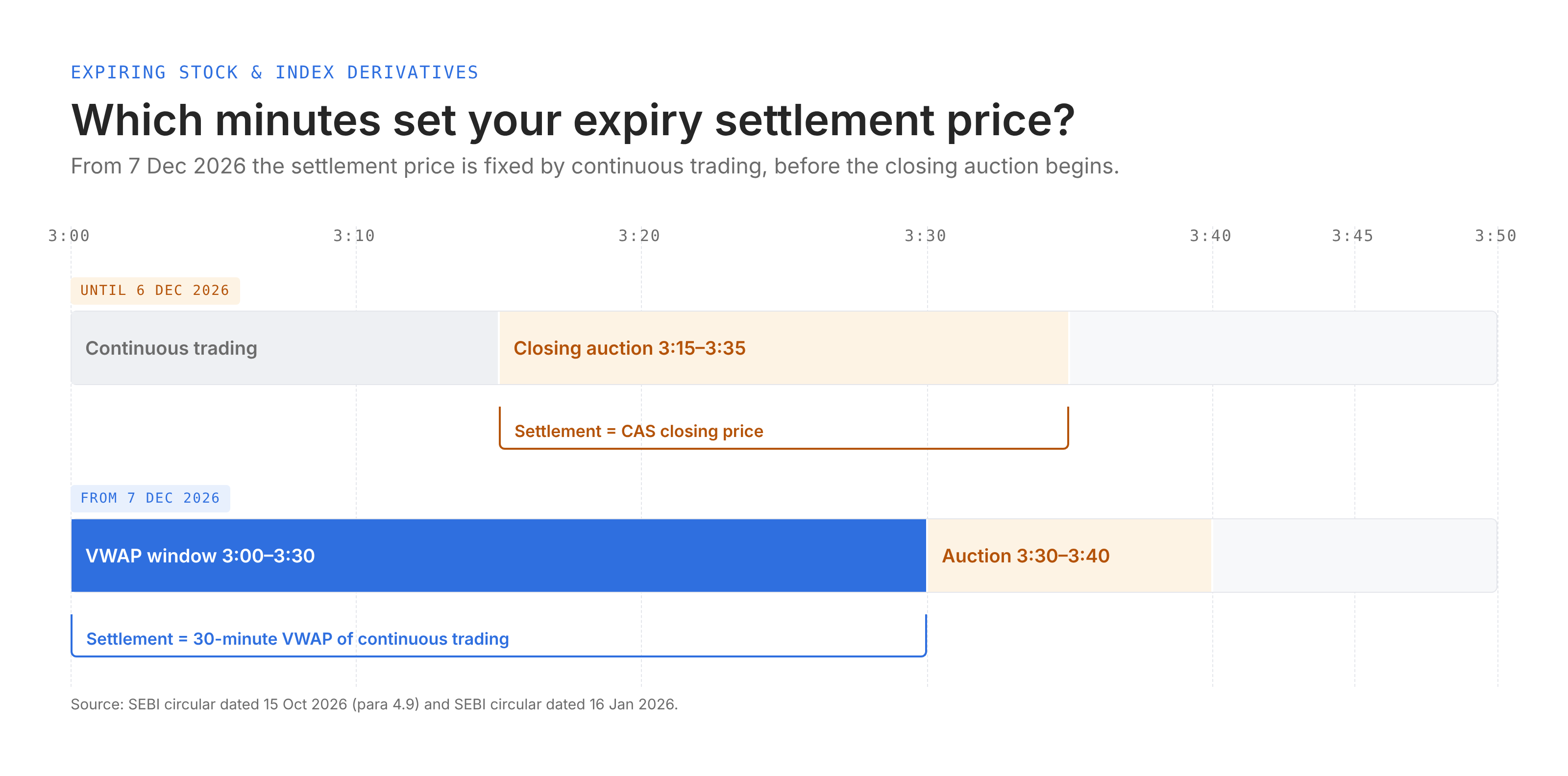
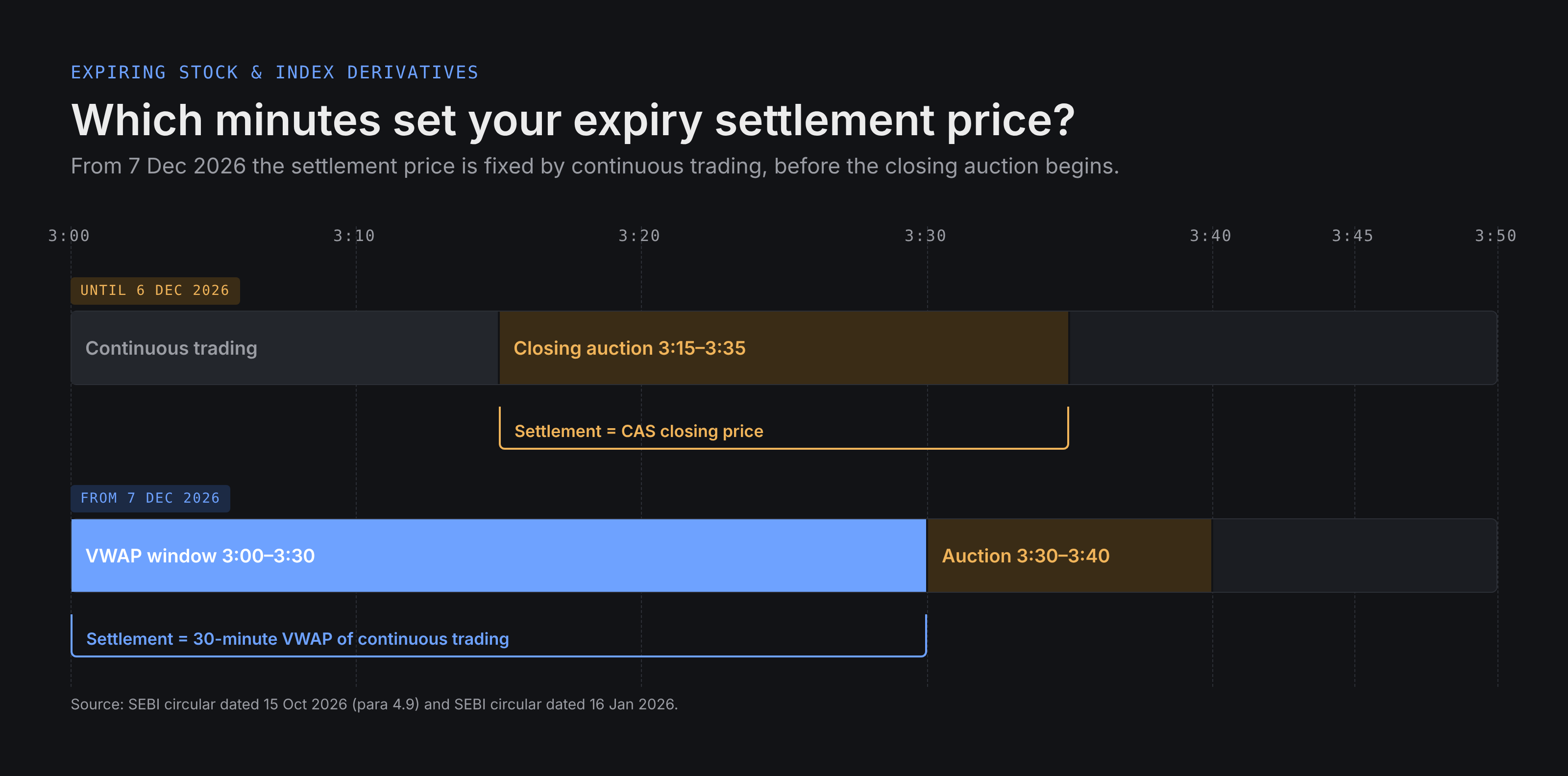
Before CAS, a stock's closing price was the VWAP of its last 30 minutes of trading, and F&O expiry settled on those closing prices. Since 3 August 2026, expiry has settled on CAS closing prices instead. From 7 December 2026, SEBI moves settlement back to a 30-minute VWAP of continuous trading, while the auction continues to set the cash-market close:
- Stock derivatives: the settlement price is the underlying stock's VWAP during the last 30 minutes of continuous trading (3:00 – 3:30 PM), across all stock exchanges. It is determined by the clearing corporations.
- Index derivatives: the settlement price is the index value calculated from the VWAP of each constituent stock during the same 30 minutes.
- Live tracking: exchanges will publish an indicative VWAP for stocks and an indicative index value in real time during that window, so you can see where settlement is heading.
In the consultation paper, SEBI described the VWAP method as an interim approach that gives continuity while CAS liquidity builds up. A blended method using both continuous trading and the auction would only be considered later, after at least a year of CAS operations.
A practical example
Suppose you hold an expiring call option on stock ABC with a strike of ₹1,500 on expiry day after 7 December 2026. Between 3:00 and 3:30 PM, ABC trades as follows (illustrative figures):
| Exchange | Shares traded, 3:00 – 3:30 PM | VWAP | Traded value |
|---|---|---|---|
| NSE | 3,00,000 | ₹1,502.40 | ₹45,07,20,000 |
| BSE | 20,000 | ₹1,503.10 | ₹3,00,62,000 |
| Total | 3,20,000 | ₹1,502.44 | ₹48,07,82,000 |
The settlement price is ₹48,07,82,000 ÷ 3,20,000 = ₹1,502.44. Your ₹1,500 call settles with an intrinsic value of about ₹2.44 per share.
Now say a burst of buy orders in the 3:30 – 3:40 PM auction pushes ABC's official closing price to ₹1,506. Under the current rules, that auction price would have driven settlement, valuing the same call at about ₹6. Under the revised rules, the ₹1,506 close becomes the day's cash-market closing price, but your option still settles at ₹1,502.44. Activity in the auction no longer changes your expiry payoff.
What it means for traders
- Option and futures traders: on expiry day, focus on the 3:00 – 3:30 PM window and the exchange's indicative VWAP or index value. Your settlement is effectively known when continuous trading ends at 3:30 PM.
- Index option traders: expiring index contracts stop trading at 3:30 PM, at the end of the settlement window. Close or roll positions before then.
- Stock F&O traders: stock derivatives, including expiring ones, trade until 3:45 PM, so you can still trade them while the auction runs.
- Cash-market and intraday traders: you get 15 more minutes of continuous trading (until 3:30 PM) for CAS stocks. Expect your broker to revise intraday auto square-off times; check their notice before 7 December.
- Investors buying at the close: the auction still sets the official closing price, and post-close orders between 3:50 and 4:00 PM still execute at that price.
- Orders left open at 3:30 PM (from 8 February 2027): unexecuted limit orders within the CAS price band will move into the auction automatically. Stop-loss orders will not. Iceberg orders will move in as fully visible limit orders unless you opted out when placing them. Cancel any order you do not want to carry into the auction.
Frequently asked questions
Are the new CAS timings in force now?
No. The revised provisions are scheduled to take effect from 7 December 2026. Until then, the current schedule (continuous trading until 3:15 PM, auction 3:15 – 3:35 PM, derivatives until 3:40 PM) applies.
What are the new closing auction timings?
From 7 December 2026, CAS runs from 3:30 PM to 3:40 PM: a 1-minute transition, market and limit orders from 3:31 to 3:36 PM, limit orders only from 3:36 PM, and order entry closing randomly between 3:38 and 3:40 PM.
How will expiring F&O contracts be settled?
On the VWAP of the last 30 minutes of continuous trading. For stock derivatives, it is the underlying stock's VWAP across all exchanges; for index derivatives, it is the index value calculated from its constituents' VWAP in that window.
Will the closing price of a stock still come from the auction?
Yes. For stocks covered by CAS, the auction's equilibrium price remains the official closing price. It simply no longer sets the settlement price for expiring derivatives.
Until when can I trade index and stock derivatives?
Until 3:45 PM on all trading days. The exception: on expiry day, expiring index derivatives stop trading at 3:30 PM. Stock derivatives trade until 3:45 PM even on their expiry day.
Has the post-close session changed?
No. The cash-segment post-close session continues from 3:50 PM to 4:00 PM, with trades executed at the closing price.
Which stocks does CAS cover?
In the current phase, CAS applies to cash-segment stocks that have derivatives contracts. Other stocks continue to close on the VWAP of the last 30 minutes. Watch NSE notices for any extension.
Conclusion
SEBI's 15 October 2026 circular fine-tunes CAS rather than replacing it. The auction still decides the cash-market closing price, but it moves to 3:30 – 3:40 PM, regular trading regains its last 15 minutes, and expiring F&O contracts go back to settling on a 30-minute VWAP of continuous trading. For F&O traders, the most important dates are 7 December 2026 for the new timings and settlement method, and 8 February 2027 for automatic carry-over of open limit orders. Until then, trade under the current rules, and check NSE's operational circulars and your broker's notices as the rollout approaches.
Official references
- SEBI circular, 15 October 2026: Review of certain aspects of the Closing Auction Session, market timings and settlement methodology for derivatives contracts (Circular No. HO/47/11/11(3)2025-MRD-POD2/I/23843/2026)
- SEBI consultation paper, 12 September 2026: Review of certain aspects of the Closing Auction Session
- SEBI circular, 16 January 2026: Introduction of Closing Auction Session (CAS) in the equity cash segment
- NSE circular 38/2026: Operational guidelines and SOP for CAS in the equity cash segment (PDF)
This article is for education only and is not investment advice. Details are as published in the SEBI circular dated 15 October 2026; exchanges may issue further operational circulars before implementation.