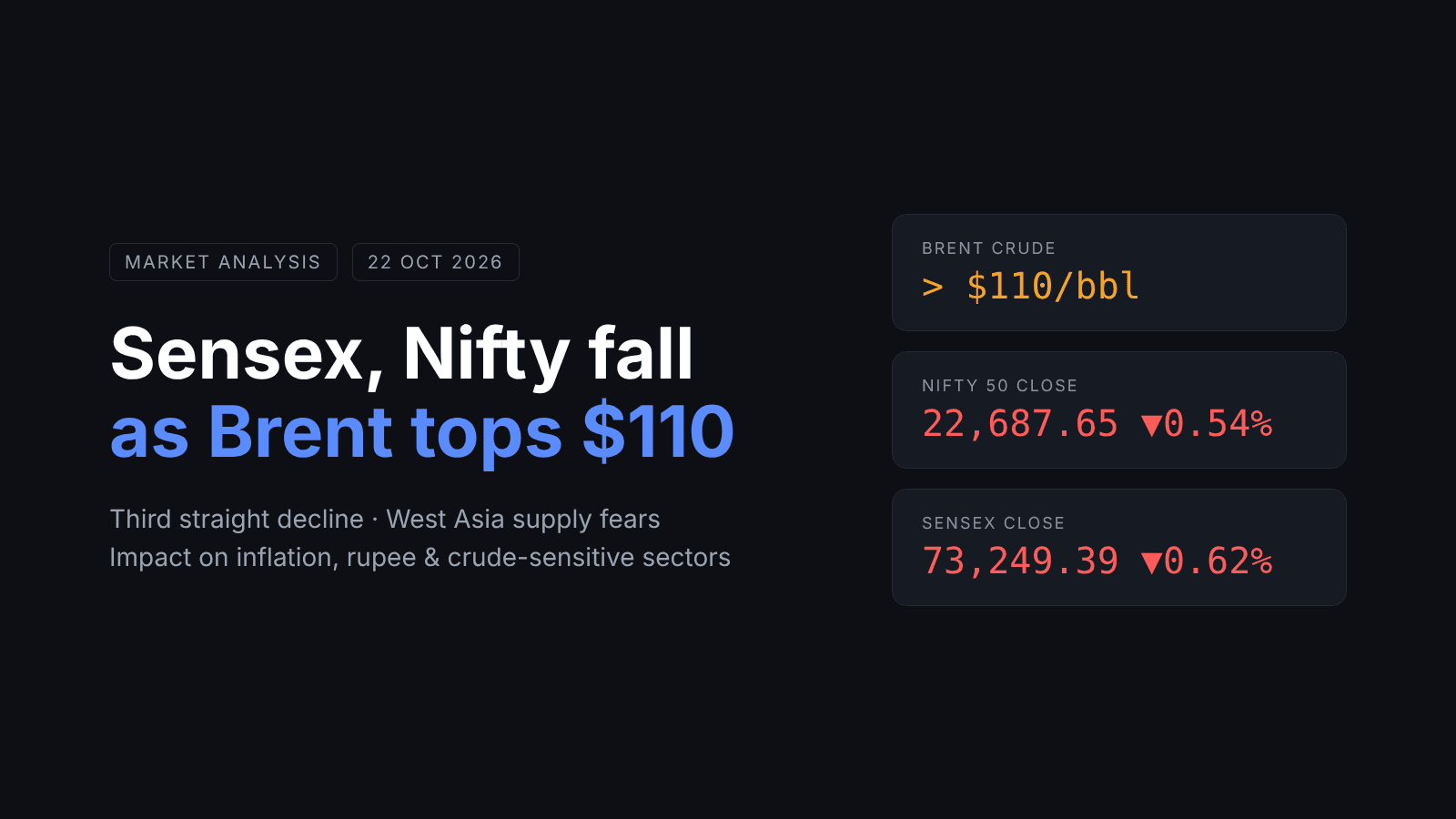
Indian Stock Market Falls as Brent Crude Oil Crosses $110: Key Reasons and Impact on Traders
Indian equities fell for a third straight session on Thursday, 22 October 2026, as Brent crude climbed back above $110 a barrel amid fresh attacks on Saudi energy infrastructure and wider West Asia tensions. For a country that imports most of its crude oil, an expensive barrel matters for inflation, the rupee and company profits. This article explains what happened, why oil jumped, which sectors are most exposed and what traders may want to watch next.
How to read this article: sections marked Confirmed data use figures reported by the sources listed at the end. Sections marked Analysis explain general cause-and-effect relationships and are not forecasts or recommendations.
Market snapshot: 22 October 2026 (Confirmed data)
| Index / asset | Level | Change |
|---|---|---|
| BSE Sensex (close) | 73,249.39 | -460.30 pts (-0.62%) |
| Nifty 50 (close) | 22,687.65 | -123.70 pts (-0.54%) |
| Nifty Midcap 100 | - | about -0.87% |
| Nifty Smallcap 100 | - | about -1.1% |
| India VIX (early trade, 9:34 am) | 16.53 | +5.45% (from 15.68) |
| Brent crude (Thursday) | above $110, reported near $112.5 later in the day | up from $108.82 settlement on 21 Oct |
Previous closes on Wednesday, 21 October 2026 were 73,709.69 for the Sensex and 22,811.35 for the Nifty 50. In early trade on Thursday the Sensex fell nearly 600 points and the Nifty dropped about 1.1% to a low of 22,557.95, before both recovered part of the loss by the close.
The previous session: 21 October 2026
On Wednesday, the Nifty 50 fell 0.34% and the Sensex 0.19%, but the damage was much bigger in the broader market: the Nifty Midcap 100 lost 1.58% and the Nifty Smallcap 100 lost 2.37%. Metal, auto, energy and realty were the main laggards, while IT was the only gaining sector that day.
Why Brent crude crossed $110 (Confirmed data)
Brent first touched $110 intraday on Friday, 16 October 2026, its highest level since 19 May, before settling at $109.86. After easing slightly, it settled at $108.82 on 21 October and moved back above $110 in Asian trade on 22 October (Reuters quoted $110.11 at 00:34 GMT). The main reasons reported:
- Attacks on Saudi energy infrastructure: a Houthi drone aimed at a processing plant at the Shaybah oilfield was intercepted on 21 October; Saudi Arabia's Energy Ministry said operations were unaffected. A separate attack hit King Fahd International Airport in Dammam. Earlier, on 5 October, crude flows on Saudi Arabia's East-West pipeline were halted after a strike on a pumping station.
- Strait of Hormuz and shipping risk: attacks around the Strait of Hormuz increased, with Iran saying it was stepping up strikes in response to a US blockade of its ports and new sanctions. Kpler counted at least 18 attacks on vessels in two weeks and reported sharply lower Gulf crude flows.
- US diplomatic signal: the US State Department ordered non-emergency government staff and families to leave Saudi Arabia, which markets read as a sign of elevated risk.
- Russia supply concerns: Ukrainian drone strikes on Russian refineries, including a unit at Ryazan, raised questions about Russian diesel exports.
- Tight US inventories: US EIA data showed crude stocks fell by 3.06 million barrels, a larger draw than expected.
Why expensive oil hurts India (Analysis)
India imports the large majority of the crude oil it uses, so a higher oil price works like a tax on the whole economy. Here is how it flows through, in simple terms.
1. Inflation
Crude is the raw material for petrol, diesel, jet fuel, plastics, paints and many chemicals. Diesel also moves almost every truckload of goods. When crude stays high, transport and input costs rise, and those costs tend to show up in prices of everyday items over time. Higher inflation can reduce the room for interest-rate cuts, which is one reason equity markets react quickly.
2. The rupee
Oil is paid for in US dollars. A costlier barrel means importers need more dollars, which puts pressure on the rupee. Reports on 22 October put the rupee near 94.50 per dollar. A weaker rupee in turn makes oil even more expensive in rupee terms, a loop that traders watch closely.
3. Import bill and current account
Simple example: if India imports roughly the same number of barrels each month, a $10 rise in the price of every barrel adds directly to the dollar import bill. The bigger the oil bill, the wider the gap between what India pays the world and what it earns, which can weigh on the currency and on foreign investor sentiment.
4. Corporate profit margins
Companies that use crude-linked inputs (fuel, plastics, packaging, chemicals) face higher costs. They can either raise prices, which may hurt demand, or absorb the cost, which hurts margins. With the earnings season under way, investors are watching for management commentary on input costs.
Sectors most sensitive to crude oil
Confirmed sector moves on 22 October: Nifty IT fell about 1.4% and was the biggest drag on the index, Nifty Auto fell about 1%, Nifty Metal about 0.8%, and Nifty Media was the weakest sectoral index. Bank Nifty held up better, down about 0.2%. Maruti Suzuki and Tata Motors Passenger Vehicles were among stocks that touched 52-week lows, and Reliance Industries, Eternal and HDFC Bank were among the top losers on the Sensex.
The sector notes below are Analysis of typical crude sensitivity, not reports of each sector's move on the day.
| Sector | Why crude matters | Indian trader example |
|---|---|---|
| Auto | Higher fuel prices can soften vehicle demand; steel, plastics and rubber costs rise. | A family delaying a car purchase because petrol is costlier hits volumes. |
| Aviation | Aviation turbine fuel (ATF) is one of an airline's largest costs and is linked to crude prices. | Airlines may raise fares, which can cool travel demand. |
| Paints | Many paint raw materials are crude derivatives. | Paint makers may need price hikes to protect margins. |
| FMCG | Packaging, palm-oil-linked inputs and freight become costlier. | Smaller pack sizes or price increases on daily-use products. |
| Oil marketing companies (OMCs) | If retail fuel prices are not raised as crude rises, marketing margins shrink. | Watch for any change in petrol and diesel pricing. |
| Tyres, chemicals, cement | Crude-linked raw materials and fuel/freight costs. | Nifty Chemicals and Cement were among the weaker indices in early trade on 22 October. |
| Upstream oil producers | Higher crude can help realisations, subject to government levies and policy. | Not every oil-linked stock falls when crude rises. |
Asian markets, India VIX and broader selling (Confirmed data)
Asian markets traded sharply lower on Thursday. In the morning, the Hang Seng was down about 2.1%, the Kospi about 1.8%, the Shanghai Composite about 1.0% and the Nikkei 225 about 0.9%; Business Standard reported that Asian indices ended the day down between 2.5% and 3.5%. US Dow futures were also lower.
India VIX, the market's fear gauge, rose 5.45% to 16.53 in early trade, showing that traders were paying more for option protection. Selling was broader than the headline indices suggest: midcaps and smallcaps fell harder than the Nifty 50 for a second straight day. Investors were also cautious ahead of the US Federal Reserve's policy meeting, with some concern about a possible rate hike.
What a rising VIX means for traders (Analysis)
India VIX measures the expected volatility of the Nifty over the next 30 days, based on option prices. When VIX rises, option premiums usually rise too. Example: an option buyer pays more for the same strike, while an option seller collects more premium but faces larger possible swings. Wider intraday ranges also mean stop-losses can be hit more easily.
What traders may want to monitor next
- Brent crude: whether it holds above $110 or falls back. Reports of attacks on Saudi facilities, Hormuz shipping and any diplomatic progress can move prices quickly.
- Rupee: movement around the 94 to 95 per dollar zone and any RBI action.
- Global cues: the US Federal Reserve decision, Asian markets and US futures before the Indian open.
- India VIX: a sustained rise signals continued nervousness; a fall would suggest calmer conditions.
- Earnings season: comments from auto, paint, FMCG, airline and OMC managements on raw material costs and pricing power.
- FII and DII flows: daily institutional buying and selling data published by the exchanges.
- Fuel price decisions: any change in retail petrol, diesel or ATF prices.
Key takeaways
- The Sensex closed at 73,249.39 (-0.62%) and the Nifty 50 at 22,687.65 (-0.54%) on 22 October 2026, a third straight decline.
- Brent crude moved above $110 on supply fears tied to attacks on Saudi infrastructure, Hormuz shipping risks and Russian refinery disruptions.
- For India, higher oil can mean higher inflation, a weaker rupee, a larger import bill and pressure on margins.
- Crude-sensitive sectors such as auto, aviation, paints, FMCG and OMCs are the ones to understand during such phases.
- Higher volatility means risk management and position sizing matter more than usual.
Frequently asked questions
Why did the Indian stock market fall on 22 October 2026?
Reported reasons include Brent crude rising above $110 a barrel, weak Asian markets, escalating West Asia tensions and caution ahead of the US Federal Reserve meeting. The Sensex fell 460.30 points and the Nifty 50 fell 123.70 points.
Why is Brent crude above $110?
Supply fears after attacks on Saudi energy sites, increased attacks on shipping around the Strait of Hormuz, US-Iran tensions, Russian refinery disruptions and a larger-than-expected fall in US crude stocks.
How does a high crude price affect the Indian rupee?
India pays for oil in dollars, so a higher oil bill increases demand for dollars, which tends to weaken the rupee.
Which sectors are most affected by rising crude oil prices?
Typically auto, aviation, paints, FMCG, tyres, chemicals and oil marketing companies, because crude-linked inputs or fuel make up a large part of their costs.
What is India VIX and why did it rise?
India VIX is an index of expected Nifty volatility derived from option prices. It rose 5.45% to 16.53 in early trade on 22 October as uncertainty increased.
Is this a good time to buy or sell stocks?
This article does not give buy or sell recommendations. Decisions should depend on your own goals, risk tolerance and research, or advice from a SEBI-registered investment adviser.
Sources
- Business Standard: Stock Market Close, 22 October 2026
- HDFC Sky: Sensex, Nifty fall after lower open as Asia slides and oil rises
- Reuters via Yahoo Finance: Oil touches $110 a barrel for first time since May
- FinanceFeeds: Brent crude at $110 after Shaybah strike
- Goodreturns: Market outlook, 22 October 2026 (21 October session data)
- NSE: India VIX historical data and BSE: index archive (official closing figures)
Disclaimer: This article is for informational and educational purposes only and is not investment advice or a recommendation to buy, sell or hold any security. Market figures are taken from the sources cited and may be revised; please verify with NSE and BSE before relying on them. Trading in securities and derivatives involves risk. SEBI studies have found that about 9 out of 10 individual F&O traders incurred net losses. Tick2Trade is a brand of Besseggen InfoTech LLP, SEBI Reg. No. INZ000213450.