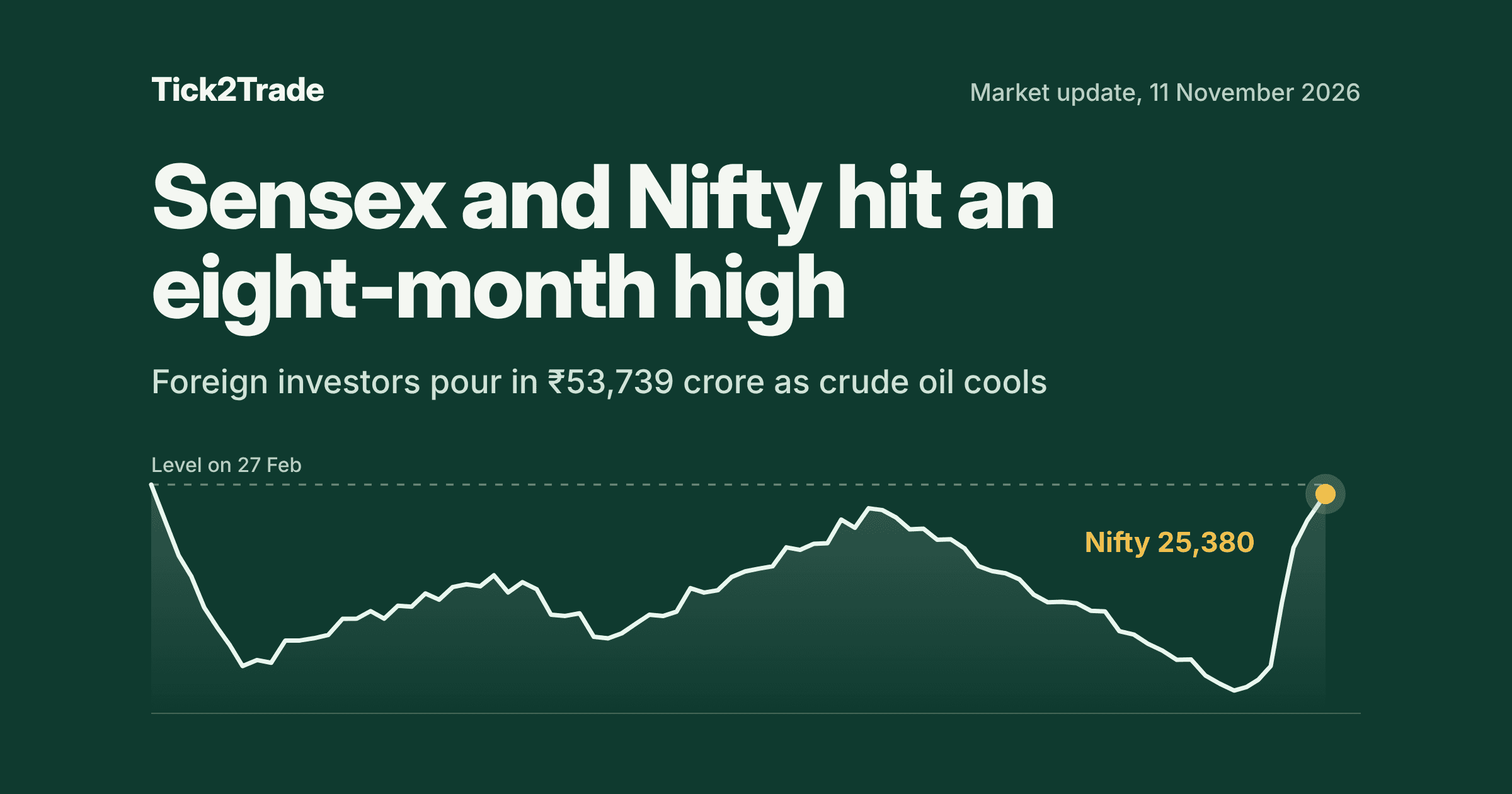


Sensex, Nifty Hit 8-Month High: 4 Reasons Behind the Rally
Indian Stock Market Hits an Eight-Month High: What’s Driving the Rally
Dalal Street is back in form. The Sensex and Nifty 50 have climbed to their highest levels since February 27, 2026, wiping out months of losses caused by the oil shock and heavy foreign selling.
On Wednesday, November 11 — the first session after the Diwali Balipratipada holiday — the Sensex jumped over 1,100 points at the open, and the Nifty crossed 25,350. The Nifty is up roughly 9–10% so far in November, and the benchmarks recently logged their longest winning streak of the year.
Here’s what is driving the rally, which sectors are leading, and what traders should keep an eye on.
Key numbers at a glance
| Indicator | Level |
|---|---|
| Sensex (Nov 11, midday) | ~82,350 (up ~1,250 points, +1.5%) |
| Nifty 50 (Nov 11, midday) | ~25,380 (up ~330 points, +1.3%) |
| Previous close (Mon, Nov 9) | Sensex 81,106.65 · Nifty 25,044.65 |
| FPI buying in November so far | ₹53,739 crore (~$5.7 billion) in six sessions |
| Brent crude | ~$92 a barrel (two-month low of $89.16 on Nov 10) |
| Rupee | ~93.7 per US dollar |
Figures are intraday as of midday on November 11, 2026, and will change by the close.
How the market got here
To understand why this high matters, look at what happened after February.
In late February, the Nifty was trading near 25,500. Then the US–Iran conflict escalated and tensions around the Strait of Hormuz sent crude oil soaring — Brent briefly crossed $120 a barrel. For India, which imports most of its oil, that meant a bigger import bill, higher inflation risk and a weaker rupee, which slid past 95 per dollar to record lows.
Foreign investors pulled out heavily. FPI outflows crossed $20 billion in the first four months of 2026, and the selling continued in waves through September and October. The Sensex fell below 75,000 at its worst points, and IT stocks were hit further by worries about AI disrupting their business.
November has flipped that story almost overnight.
4 reasons the market is rallying
1. Foreign investors are buying again
This is the biggest driver. FPIs bought ₹53,739 crore of Indian shares in just six trading sessions between November 2 and 9 — including ₹7,212 crore on Monday alone. Compare that with net outflows of about ₹34,800 crore in October and ₹35,900 crore in September. November is on track for the largest foreign inflows since September 2024.
When foreign money returns, it usually flows first into large, liquid stocks — especially big banks and financials — which carry heavy weight in the Nifty and Sensex.
2. Crude oil is cooling
Brent crude fell to a two-month low of $89.16 a barrel on November 10, after US officials played down the chance of further military action against Iran. Cheaper oil is good news for India on several fronts: a smaller import bill, lower inflation pressure, and support for the rupee.
3. Q2 earnings beat expectations
The rally isn’t only about flows. Nifty 50 companies reported earnings growth of about 24% in the September quarter — a 12-quarter high, according to Geojit’s V K Vijayakumar. Strong earnings make current valuations easier to justify.
4. The global AI trade is cooling
Through much of 2026, global investors poured money into AI and chip stocks in other markets. As that trade loses steam, investors are rotating back into markets like India that were left behind.
Sectors leading and lagging
Leading: PSU banks were the top-performing sector on Wednesday, followed by autos, financials and consumer durables. InterGlobe Aviation (IndiGo), Mahindra & Mahindra and State Bank of India were among the top Nifty gainers — airlines and automakers both benefit directly from cheaper fuel.
Broader market: The Nifty Smallcap index rose about 1.3% by midday, keeping pace with the benchmarks, while the Nifty Midcap index gained a more modest 0.7%.
Lagging: Pharma was the weakest sector. IT stocks have been volatile — the Nifty IT index fell over 1% on Monday — though easing pressure on global chip stocks helped sentiment on Wednesday.
Risks to watch
An eight-month high is good news, but a few warning signs are worth tracking:
- Domestic institutions are selling into the rally. DIIs sold about ₹7,170 crore on Monday — almost exactly offsetting FII buying. If foreign flows slow, the market loses its main buyer.
- Oil is still sensitive to Iran headlines. Brent near $90 is far below the peak, but any fresh escalation could reverse the move quickly.
- The rupee is still weak. At around 93.7 per dollar, it is near historic lows. A stronger rupee would make the foreign inflows more durable.
- The rally has been fast. A gain of nearly 10% in a few weeks can invite profit-booking. Sharp up-moves are often followed by pauses or pullbacks.
What this means for traders
- Track FII flow data daily. Foreign buying is powering this rally. NSE publishes provisional FII/DII figures every evening — a shift back to selling is an early warning sign.
- Watch crude and the rupee together. Falling oil and a firming rupee support the rally; a reversal in either can hit oil-sensitive sectors like aviation, autos and paints first.
- Don’t chase gaps. After a near-10% run, buying at the open on big gap-up days carries more risk. Waiting for pullbacks or using stop-losses helps manage it.
- Late-February levels are the next reference point. The Nifty was near 25,500 before the sell-off began; many traders will watch how the index behaves around that zone.
- F&O traders: note the new timings. From December 7, NSE F&O trading extends to 3:45 PM and expiry settlement moves to a 30-minute VWAP. (Internal link: NSE F&O timings change post.)
FAQs
1. Why did the Sensex and Nifty hit an eight-month high? Mainly because foreign investors returned with heavy buying, crude oil prices fell to a two-month low, and Q2 company earnings came in stronger than expected.
2. When was the market last at this level? The Sensex and Nifty are at their highest levels since February 27, 2026, before the US–Iran conflict pushed oil prices sharply higher.
3. How much have FPIs invested in November 2026? About ₹53,739 crore (around $5.7 billion) in the first six trading sessions of the month, per depository data.
4. Which sectors are leading the rally? PSU banks, autos, financials and consumer durables. Pharma has lagged.
5. Is it too late to invest? No one can say for sure. The rally has been fast, so short-term pullbacks are possible. Long-term investors usually focus on asset allocation and staggered investing rather than timing the market.
The Indian stock market’s eight-month high is built on three things: returning foreign money, cheaper oil and strong earnings. As long as FPIs keep buying and crude stays calm, the momentum has support. But with domestic institutions selling and oil still tied to Iran headlines, traders should enjoy the rally with a plan — not on autopilot.
Disclaimer: This article is for educational purposes only and is not investment advice. Market figures are as of midday on November 11, 2026. Please consult a SEBI-registered adviser before making investment decisions.


