

NSE Revises Index F&O Freeze Limits from 2 November 2026: New Limits for Nifty, BankNifty and More
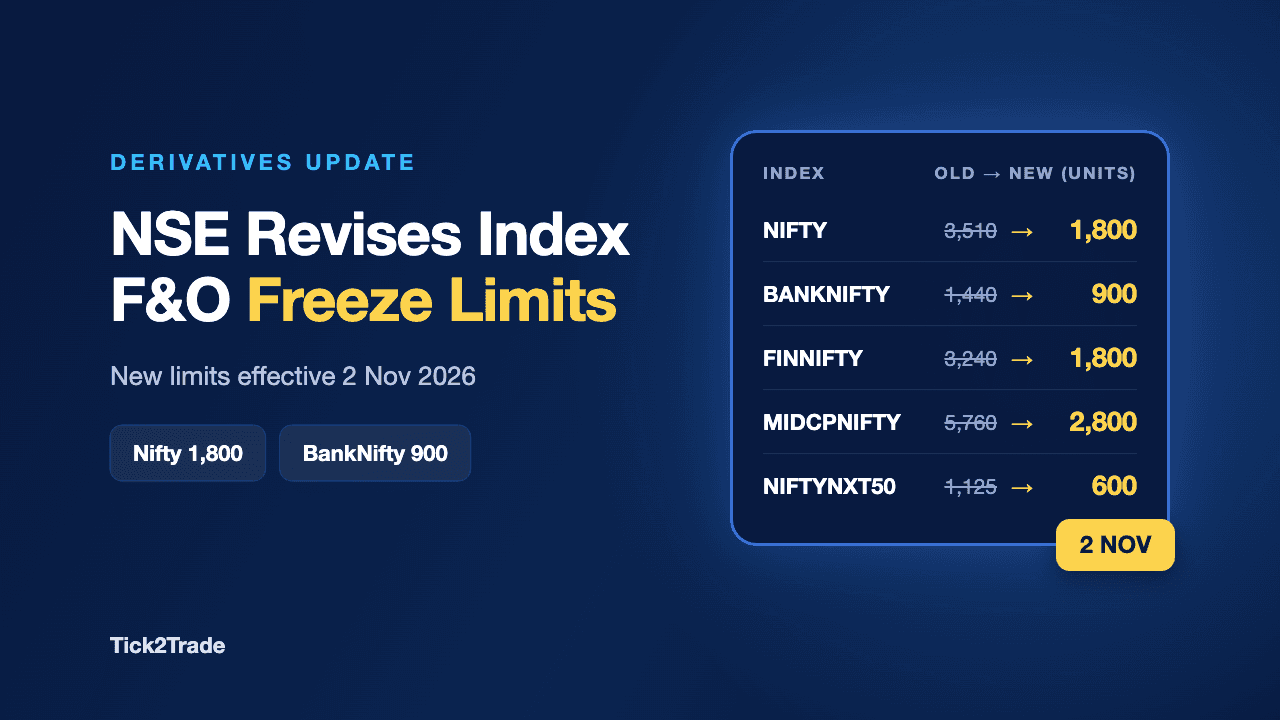
NSE has revised the quantity freeze limits for index futures and options contracts, and the new limits apply from Monday, 2 November 2026. Under NSE circular 149/2026 (reference NSE/FAOP/77189), issued on 30 October 2026, the freeze limit for Nifty comes down to 1,800 units per order, BankNifty to 900, FinNifty to 1,800, Midcap Nifty to 2,800, Nifty Next 50 to 600 and Nifty FPI to 8,500.
The change reverses most of the sharp increase NSE made just a month earlier. On 5 October 2026 (circular 136/2026, NSE/FAOP/76693), freeze limits had been raised to 3,510 for Nifty, 1,440 for BankNifty, 3,240 for FinNifty, 5,760 for Midcap Nifty, 1,125 for Nifty Next 50 and 53,900 for Nifty FPI. From 2 November, they move back down.
What is a freeze quantity?
A freeze quantity is the maximum number of units that can be sent in a single F&O order. If an order is larger than the limit, the exchange system rejects it automatically. It exists to stop accidental oversized orders (fat-finger errors) and to protect market stability. It is a limit on the size of one order, not a cap on the total position you can hold, so a bigger trade has to be split into several orders.
Revised freeze limits for index derivatives from 2 November 2026
| Index | Existing limit (from 5 Oct 2026) | New limit (from 2 Nov 2026) | Change |
|---|---|---|---|
| NIFTY | 3,510 | 1,800 | -48.7% |
| BANKNIFTY | 1,440 | 900 | -37.5% |
| FINNIFTY | 3,240 | 1,800 | -44.4% |
| MIDCPNIFTY | 5,760 | 2,800 | -51.4% |
| NIFTYNXT50 | 1,125 | 600 | -46.7% |
| NIFTYFPI | 53,900 | 8,500 | -84.2% |
All limits are in units (quantity), not lots.
What it means in lots
Because orders must be placed in whole lots, the practical maximum per order is the new limit rounded down to a whole number of lots. Based on the current lot sizes, the effective per-order maximum works out as follows:
| Index | Lot size | Maximum lots per order | Maximum quantity per order |
|---|---|---|---|
| NIFTY | 65 | 27 | 1,755 |
| BANKNIFTY | 30 | 30 | 900 |
| FINNIFTY | 60 | 30 | 1,800 |
| MIDCPNIFTY | 120 | 23 | 2,760 |
| NIFTYNXT50 | 25 | 24 | 600 |
| NIFTYFPI | - | 7 | 7,700 |
For example, a single Nifty order can be at most 27 lots (1,755 units). An order for 3,055 units would be rejected, and would need to be split into two orders, such as 1,755 and 1,300.
Why the numbers moved
NSE's circular does not give a specific reason for the revision. It states that the limits are computed as per chapter 1.9 (Quantity freeze for futures and options contracts) of the F&O consolidated circular NSE/FAOP/73928 dated 28 April 2026. The October circular had said the computation methodology in that consolidated circular would not apply to indices and that the specified freeze limits would apply instead.
What traders should do
- Check your order sizes. Any single order above the new limit for the index you trade will be rejected from 2 November 2026.
- If you trade large quantities in Nifty, BankNifty or other indices, split orders into lots that stay within the new limits, or use your broker's order slicing feature if it offers one.
- Review any algo, basket or strategy settings that were built around the higher October limits, and update the maximum quantity per order.
- Keep in mind that sliced orders are executed separately, so fills and prices can differ slightly from one large order.
Instructions for trading members
NSE has asked trading members to upload the updated contract.gz and NSE_FO_contract_ddmmyyyy.csv.gz files into their trading applications before trading on 2 November 2026. The files are available in the faoftp/faocommon directory on the Extranet server, and the contract file is also on the NSE website under all-reports-derivatives. Freeze details for each underlying can be seen on NSE's equity derivatives contract information page.
Freeze limits are revised from time to time, so always check the latest NSE circular before placing large index orders.
This article is for educational purposes only and is not investment advice. Please refer to the official NSE circular for the authoritative details.


