NSE Changes F&O Trading Timings and Closing Auction Rules from December 7, 2026
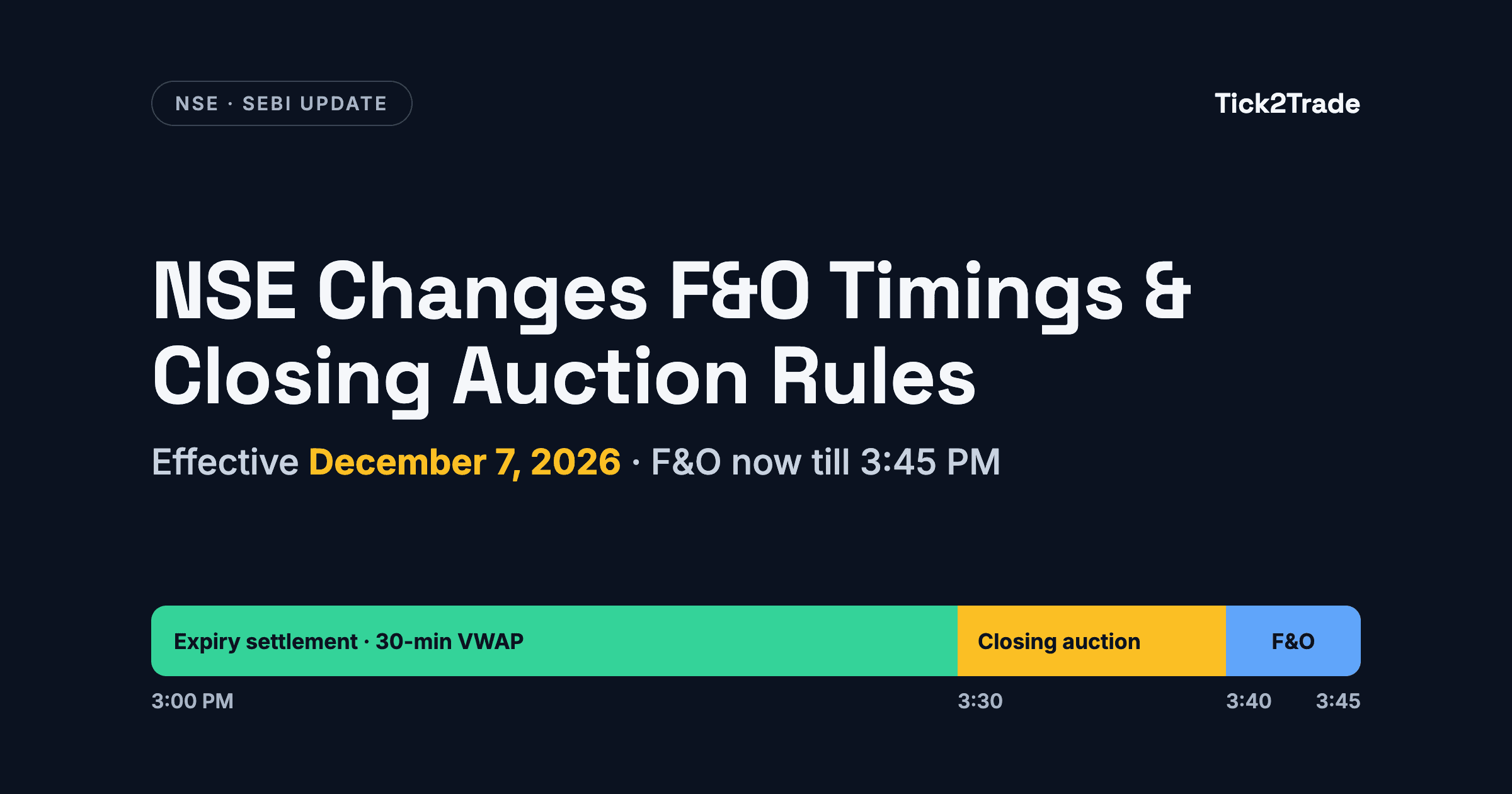
From Monday, December 7, 2026, the last 30 minutes of the Indian trading day will look very different. NSE is shortening the Closing Auction Session (CAS) to 10 minutes, moving it to 3:30–3:40 PM, extending F&O trading to 3:45 PM, and — most importantly — ending the link between the closing auction and F&O expiry settlement.
If you trade options or futures on expiry day, this is the change you need to understand before it goes live.
The changes at a glance
- All stocks trade normally till 3:30 PM — F&O stocks no longer stop early at 3:15 PM.
- CAS shrinks from 20 minutes to 10 minutes and now runs from 3:30 PM to 3:40 PM.
- F&O trading extends to 3:45 PM (from 3:40 PM).
- Expiry settlement moves to a 30-minute VWAP of 3:00–3:30 PM, instead of the CAS closing price.
- Expiring index contracts stop at 3:30 PM on expiry day; expiring stock contracts keep trading till 3:45 PM.
Why NSE is changing a system that is only four months old
The closing auction went live on August 3, 2026. Under that framework, F&O-eligible stocks stopped regular trading at 3:15 PM and moved into a 20-minute auction that set their official closing price. F&O contracts traded till 3:40 PM.
The catch: on expiry day, the closing price discovered in that auction was also used as the final settlement price for expiring stock and index derivatives. A single auction print was deciding how every expiring option paid out.
After market feedback and sharp end-of-day moves in the early weeks of CAS, SEBI reviewed the closing auction, market timings and the derivatives settlement method. It issued a revised framework in October 2026, and NSE has now notified the new trading modalities effective December 7, 2026.
Old vs new market timings
| Session | Till Dec 4, 2026 | From Dec 7, 2026 |
|---|---|---|
| Market open (cash and F&O) | 9:15 AM | 9:15 AM (no change) |
| Regular trading — non-F&O stocks | Till 3:30 PM | Till 3:30 PM (no change) |
| Regular trading — F&O stocks | Till 3:15 PM | Till 3:30 PM |
| Closing Auction Session (CAS) | 3:15–3:35 PM (20 min) | 3:30–3:40 PM (10 min) |
| Index F&O trading | Till 3:40 PM | Till 3:45 PM |
| Stock F&O trading | Till 3:40 PM | Till 3:45 PM |
| Expiring index F&O (expiry day) | Till 3:40 PM | Till 3:30 PM |
| Expiring stock F&O (expiry day) | Till 3:40 PM | Till 3:45 PM |
| Expiry settlement price | CAS closing price | 30-min VWAP, 3:00–3:30 PM |
How the new 10-minute closing auction works
CAS still decides the official closing price of every stock that has derivatives on any exchange. It now runs after regular trading ends, in four quick phases:
- 3:30–3:31 PM — Reference price. The exchange calculates each stock’s reference price from the VWAP of trades between 3:15 PM and 3:30 PM.
- 3:31–3:36 PM — Market and limit orders. You can place both order types.
- 3:36 PM onwards — Limit orders only. Market orders are no longer accepted.
- 3:38–3:40 PM — Random close. Order entry stops at a random moment in this window, then orders are matched to find the closing price.
Two guardrails matter for traders:
- Price band of ±3% around the reference price during CAS.
- Random close makes it harder to dump a large order in the last second and move the close.
CAS will not apply to a stock on the ex-date of a scheme of arrangement. And from February 8, 2027, eligible iceberg orders left over from regular trading will enter the auction as fully disclosed limit orders, unless the trader opts out.
The big one: expiry settlement moves to a 30-minute VWAP
This is the change with the most impact on your P&L. From December 7, expiring F&O contracts will no longer settle at the CAS closing price.
- Stock F&O will settle at the stock’s volume-weighted average price (VWAP) across exchanges from 3:00 PM to 3:30 PM.
- Index F&O (Nifty, Bank Nifty and others) will settle on an index value built from the 30-minute VWAPs of its constituent stocks.
- Exchanges will publish indicative VWAPs and index values in real time during the 3:00–3:30 PM window, so you can track where settlement is heading.
Why VWAP? A price averaged over 30 minutes of real trading is much harder to push around than a single auction print. A late order imbalance in the auction can no longer flip an option from in-the-money to out-of-the-money. It also reduces basis risk — the gap between where you hedge and where your contract actually settles.
Simple example: Suppose a stock trades between ₹998 and ₹1,004 from 3:00 to 3:30 PM, with most volume near ₹1,001. Its settlement price will be close to ₹1,001 — even if the closing auction later prints ₹1,010. Your ₹1,000 call settles at about ₹1, not ₹10.
Expiry day: index and stock contracts now behave differently
On regular days, all index and stock F&O contracts trade till 3:45 PM. Expiry day is where the rules split.
| Contract on expiry day | Trading stops | Settlement window |
|---|---|---|
| Expiring index F&O | 3:30 PM | 3:00–3:30 PM VWAP |
| Non-expiring index F&O | 3:45 PM | — |
| Expiring stock F&O | 3:45 PM | 3:00–3:30 PM VWAP |
| Non-expiring stock F&O | 3:45 PM | — |
Notice the gap for stock derivatives: expiring stock contracts keep trading for 15 minutes after their settlement price is already locked. Between 3:30 and 3:45 PM, stock futures price bands will follow the CAS band, and dynamic band flexing (automatic widening of price bands) will be paused. It stays active during regular trading.
What traders should do differently from December 7
- Watch 3:00–3:30 PM on expiry day. That half hour now decides your settlement. Track the indicative VWAP the exchanges publish, not just the live price.
- Close expiring index positions before 3:30 PM. There is no extra time after that — those contracts simply stop trading.
- Don’t trade expiring stock F&O blindly after 3:30 PM. The settlement price is already fixed; prices in the last 15 minutes don’t change where the contract settles.
- Intraday stock traders get 15 more minutes. F&O stocks now trade normally till 3:30 PM instead of 3:15 PM, so square-off timings at your broker may change. Check your broker’s auto square-off time.
- Use limit orders if you join the auction. Market orders are allowed only until 3:36 PM, and the ±3% band applies.
- Update your algos and alerts. Any strategy, timer or alert built around 3:15, 3:35 or 3:40 PM needs to be reset.
FAQs
1. When do the new NSE F&O timings start? From Monday, December 7, 2026.
2. What is the new F&O closing time? 3:45 PM for both index and stock F&O. On expiry day, expiring index contracts close at 3:30 PM.
3. Is the Closing Auction Session being removed? No. CAS stays and still sets the official closing price of F&O stocks. It is just shorter (10 minutes) and runs from 3:30 to 3:40 PM.
4. How will expiring options and futures be settled now? At the volume-weighted average price of the last 30 minutes of regular trading (3:00–3:30 PM), not the CAS closing price. Index contracts settle on an index value built from constituent VWAPs.
5. Do timings change for stocks not in F&O? No. They continue to trade till 3:30 PM and are not part of CAS.
6. Why is the close random between 3:38 and 3:40 PM? A random end stops traders from timing a large order in the final second to move the closing price.
7. Who announced these changes? SEBI revised the framework in October 2026, and NSE notified the new trading modalities in November 2026.
The December 7 overhaul gives traders a longer day and a fairer expiry. Regular trading runs till 3:30 PM for every stock, F&O trades till 3:45 PM, and your expiring contracts settle on 30 minutes of real trading instead of one auction print. Mark 3:00–3:30 PM on expiry day in your calendar — that is now the window that counts.
Disclaimer: This article is for educational purposes only and is not investment advice. Timings are based on SEBI and NSE announcements as of November 9, 2026; always confirm with the official NSE circular and your broker before trading.


